
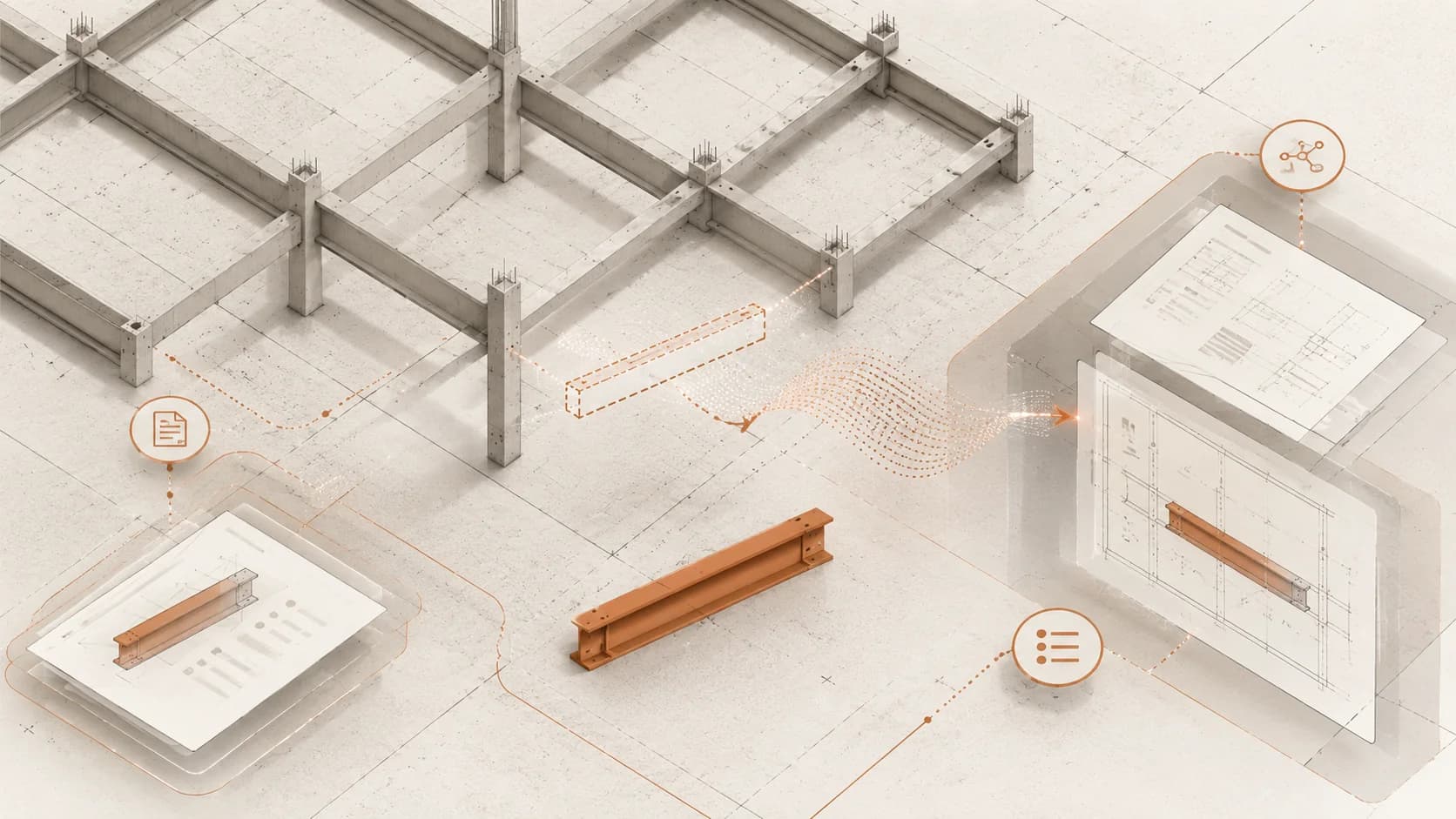
The Missing Steel Beam That Halted a Project
How fragmented construction documentation turns minor material issues into major crises - and how AI document intelligence resolves them fast.
Quick Answer
A missing steel beam caused days of project delay while teams scrambled through hundreds of documents. This story illustrates how fragmented construction documentation turns minor material issues into major operational crises - and how Brickato's AI-powered document intelligence resolves them in minutes.
Table of Contents
- The Hidden Cost of Document Chaos
- Why This Keeps Happening
- How Brickato Solves This in Minutes
- What the Resolution Process Looks Like With Brickato
- The Broader Impact on Project Delivery
The Story
It was a Tuesday morning when the site foreman sent the message no project manager wants to receive: "The steel beam for grid line C-7 isn't here. Can't proceed. Who do we call?"
What followed was a cascade of phone calls, emails, and frantic searches through folders on three different shared drives. The procurement team pointed to the purchase order. The PM pointed to the submittal log. The supplier pointed to a delivery confirmation that nobody could locate. Meanwhile, a crew of twelve stood idle on site - costing thousands of dollars per hour.
This scenario plays out on construction sites every week, across every project size. A missing material item is not inherently a crisis. What turns it into a crisis is the inability to quickly answer four simple questions: Was it ordered? Was it approved? Was it delivered? Where is the documentation?
The Hidden Cost of Document Chaos
Construction projects generate an extraordinary volume of documentation. A mid-scale commercial project might involve thousands of submittals, hundreds of RFIs, dozens of purchase orders, delivery receipts, inspection logs, and change orders - all stored across different systems, email threads, and file servers.
When something goes wrong on site, the instinct is to call someone who might know. But that someone is often in a meeting, off-site, or dealing with three other problems simultaneously. The answer that should take seconds instead takes hours - or days.
Key statistics:
- 5.5 hours per week lost to manual document searching per professional
- 280+ hours annually wasted per team member on avoidable information hunts
- 500+ pages in a typical project specification where critical details hide
For the steel beam scenario, the team spent nearly two full days piecing together the chain of events. The beam had been ordered, approved, and delivered - but delivered to the wrong staging area and logged under a slightly different item description in the delivery records. Nobody had cross-referenced the submittal approval against the delivery receipt, because doing so manually would have required pulling three separate documents from two separate systems.
"Two days of crew downtime. Change order disputes. Rescheduled inspections. All because the answer was sitting in the documents the whole time - and nobody could find it fast enough."
Why This Keeps Happening
The problem is not that construction teams lack documentation discipline. Most project teams are meticulous about recording what happens. The problem is that information is fragmented by design: procurement lives in one system, submittals in another, delivery confirmations arrive by email, and site logs are kept locally. There is no single place to ask a question and get a complete answer.
When a field issue arises, resolving it requires a person who either has all the context in their head - which is rarely one person - or who is willing to spend the time assembling that context from disparate sources. Neither option is fast. Neither option scales.
The result is that resolving even straightforward field questions becomes a multi-hour investigative exercise. And while the investigation is underway, the site waits.
How Brickato Solves This in Minutes
AI-Powered Document Intelligence for Construction Teams
Brickato ingests your entire project document library - purchase orders, submittals, RFIs, delivery receipts, specifications, drawings, change orders, and more - and makes every piece of information instantly searchable through natural language.
Instead of calling three people and searching two shared drives, a project manager simply asks: "Has the W12×50 beam for grid line C-7 been approved and delivered?" Brickato cross-references the submittal log, the purchase order, and the delivery records in seconds - and returns a precise, sourced answer.
No training required. No new workflow to adopt. Just ask the question you need answered.
What the Resolution Process Looks Like With Brickato
Step 1 - Seconds: The PM or site supervisor types a natural language query: "Show me the submittal approval and delivery confirmation for the structural steel at grid C-7."
Step 2 - Seconds: Brickato searches across all project documents simultaneously. The AI engine scans submittals, purchase orders, delivery logs, and RFIs in parallel - regardless of file format or storage location.
Step 3 - Under 2 Minutes: A complete, sourced answer is returned. Brickato surfaces the relevant documents with direct references: submittal approved on date X, PO issued on date Y, delivery signed off under item description Z - with the exact document excerpts cited.
Step 4 - Immediate: The team acts - not investigates. Armed with complete information, the PM can immediately redirect the crew, contact the correct staging area, or escalate to the supplier with documented evidence in hand.
"What used to take us two days of back-and-forth now takes a few minutes. Brickato doesn't just search documents - it understands construction context and connects the dots across our entire project record."
Senior Project Manager, Commercial Construction
The Broader Impact on Project Delivery
The steel beam incident is a useful example precisely because it feels minor - a single material item, a single grid line. But its resolution consumed two days of downtime, triggered a change order dispute, and required rescheduling a structural inspection. The real cost was multiples of the beam's own price.
When teams have immediate access to complete project information, they don't just resolve incidents faster. They prevent them. Site supervisors who can verify procurement status in real time catch delivery discrepancies before the crew arrives. PMs who can query submittal approval history don't wait for inspection confirmations by phone. The entire operational cadence accelerates.
Brickato's document intelligence platform brings construction project knowledge out of fragmented filing systems and into the hands of the people making decisions on the ground - in seconds, not hours.