
How Untracked Quality Defects Become Expensive Rework
Undocumented quality non-conformances compound into defects lists and warranty claims. How cross-document quality intelligence closes the gap.
Quick Answer
Quality non-conformances that go undocumented don't disappear - they compound into defects lists, stalled handovers, and warranty claims. This article examines why quality issues go untracked on construction sites and how Brickato's cross-document quality intelligence closes the gap between what's observed and what's formally recorded.
Table of Contents
- Why Quality Issues Go Untracked
- The Invisible Quality Gap
- How Brickato Brings Quality Intelligence to Your Project
- Beyond Tracking: Proactive Quality Governance
The Story
The inspection had been conducted. The inspector had noticed that the waterproofing membrane installation in the basement car park appeared inconsistent in two areas - variations in lap joint width that fell outside the specification tolerance. He mentioned it verbally to the subcontractor's foreman. The foreman said he'd look into it. No NCR was raised. No written record was created.
Six months later, during the defects liability period, water ingress appeared in exactly those two areas. The investigation that followed required pulling inspection records, specification documents, subcontract clauses, and material data sheets - all to establish what had been installed, what had been inspected, and whether the issue had been previously identified. The paper trail was incomplete. The dispute that followed was expensive for everyone.
This scenario illustrates one of the most persistent and underappreciated risks in construction project management: the quality issue that everyone saw, nobody formally recorded, and that quietly matured into a much larger problem downstream.
Why Quality Issues Go Untracked
Construction sites are fast-moving environments where the pressure to maintain programme often outweighs the discipline to maintain records. When a supervisor identifies a potential non-conformance, the path of least resistance is a verbal conversation with the responsible party, a mental note to follow up, and a return to the dozens of other priorities competing for attention.
The NCR (Non-Conformance Report) process exists precisely to prevent this. But in practice, raising an NCR requires navigating a quality management system, completing paperwork, and initiating a formal process that many site personnel find cumbersome. The result is that minor quality observations - the kind that individually might be addressable in minutes - go unrecorded until they accumulate into something that cannot be ignored.
A Typical Untracked Quality Chain
Concrete pour observed with surface voids → foreman told verbally → subcontractor patches two areas → rest remains unaddressed → inspection passed informally → defect appears at practical completion → no documentation of original observation → full reinvestigation required at cost to the project.
But the problem is not only about what isn't recorded. It is also about what is recorded but not connected. Quality records on complex projects exist across multiple formats and systems: daily site reports, inspection test plans, hold point registers, material test certificates, non-conformance logs, and RFI responses. Each document may contain quality-relevant information. None of them talk to each other.
Key statistics:
- 12% of total project value typically spent on rework due to quality failures
- 40% of rework costs attributable to issues that were previously observed but not formally recorded
- 3x more expensive to rectify a quality issue discovered at handover vs. at point of construction
"The inspection records showed passing results. The daily reports mentioned concerns informally. The specification clearly stated the requirement. Nobody had ever put them in the same room - until the defect claim arrived."
The Invisible Quality Gap
What makes quality tracking failures particularly costly in construction is the time delay between the original deficiency and its visible consequence. A waterproofing issue manifests months after installation. A structural deficiency may not become apparent until load is applied. A finishing trade defect hidden behind a subsequent trade's work may not be discovered until a future renovation uncovers it under warranty.
By the time the consequence is visible, the evidence trail that would allow rapid, clear attribution has deteriorated. People have moved on. Records have been archived. And the project is in a financial dispute over a problem that could have been documented and resolved for a fraction of the cost at the time it was first observed.
How Brickato Brings Quality Intelligence to Your Project
Cross-Document Quality Analysis That Catches What Falls Through the Cracks
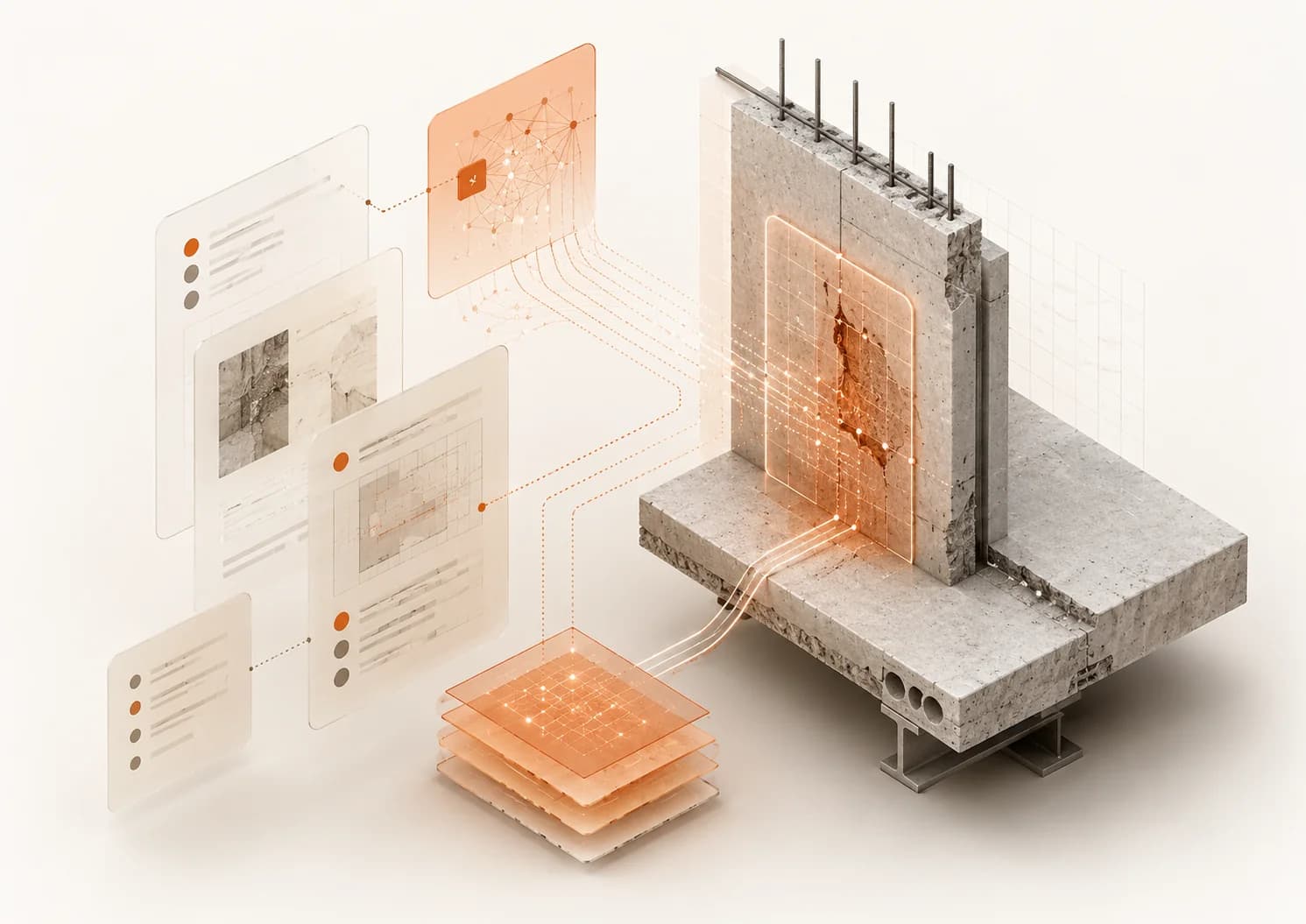
Brickato ingests your complete project quality documentation - inspection test plans, NCR logs, daily site reports, material test certificates, specification requirements, and RFI responses - and applies AI-powered analysis to detect patterns, gaps, and discrepancies that manual review would miss.
Ask Brickato: "Are there any areas where daily reports mention quality concerns that haven't been followed up with a formal NCR?" The system cross-references your site diaries against your NCR register and flags the gaps - turning informal observations into trackable issues before they become expensive defects.
Or ask: "Show me all inspection records for the Level 3 structural slab and flag any that indicate retesting or conditional passing." Brickato assembles the complete quality history for any scope element in seconds, from across all your project documents.
Without Brickato vs. With Brickato
Without Brickato:
- Verbal observations never reach the NCR register
- Quality records in separate systems never cross-referenced
- Specification requirements and test results reviewed in isolation
- Defect history reconstructed under pressure during disputes
- Repeated non-conformances in the same area go unnoticed
With Brickato:
- All quality-relevant information connected across document types
- Informal site report observations flagged against NCR register
- Specification requirements automatically cross-referenced with test results
- Complete quality history for any scope item available in seconds
- Anomaly detection surfaces recurring issues before they escalate
"We used to find out about quality issues when the defects list came in at practical completion. Now we catch them in our weekly quality review - because Brickato shows us exactly where our inspection records and our NCR register aren't telling the same story."
Quality Manager, High-Rise Residential Project
Beyond Tracking: Proactive Quality Governance
The most powerful application of Brickato in quality management is not retrospective - it is preventive. When project teams can instantly see the complete quality record for any element of work, and when the system actively surfaces discrepancies between what was specified, what was inspected, and what was formally recorded, the entire culture of quality management shifts.
Supervisors who know that site diary comments will be cross-referenced against inspection records are more likely to formalise observations in real time. Project managers who can pull a complete quality history for any zone or trade package in seconds can conduct meaningful quality reviews without spending hours assembling data. And at practical completion, the transition from construction to defects management becomes a controlled handover rather than a forensic exercise.
Brickato does not replace a quality management system. It makes your existing quality documentation - however distributed, however inconsistently maintained - intelligently searchable and analytically coherent for the first time.