
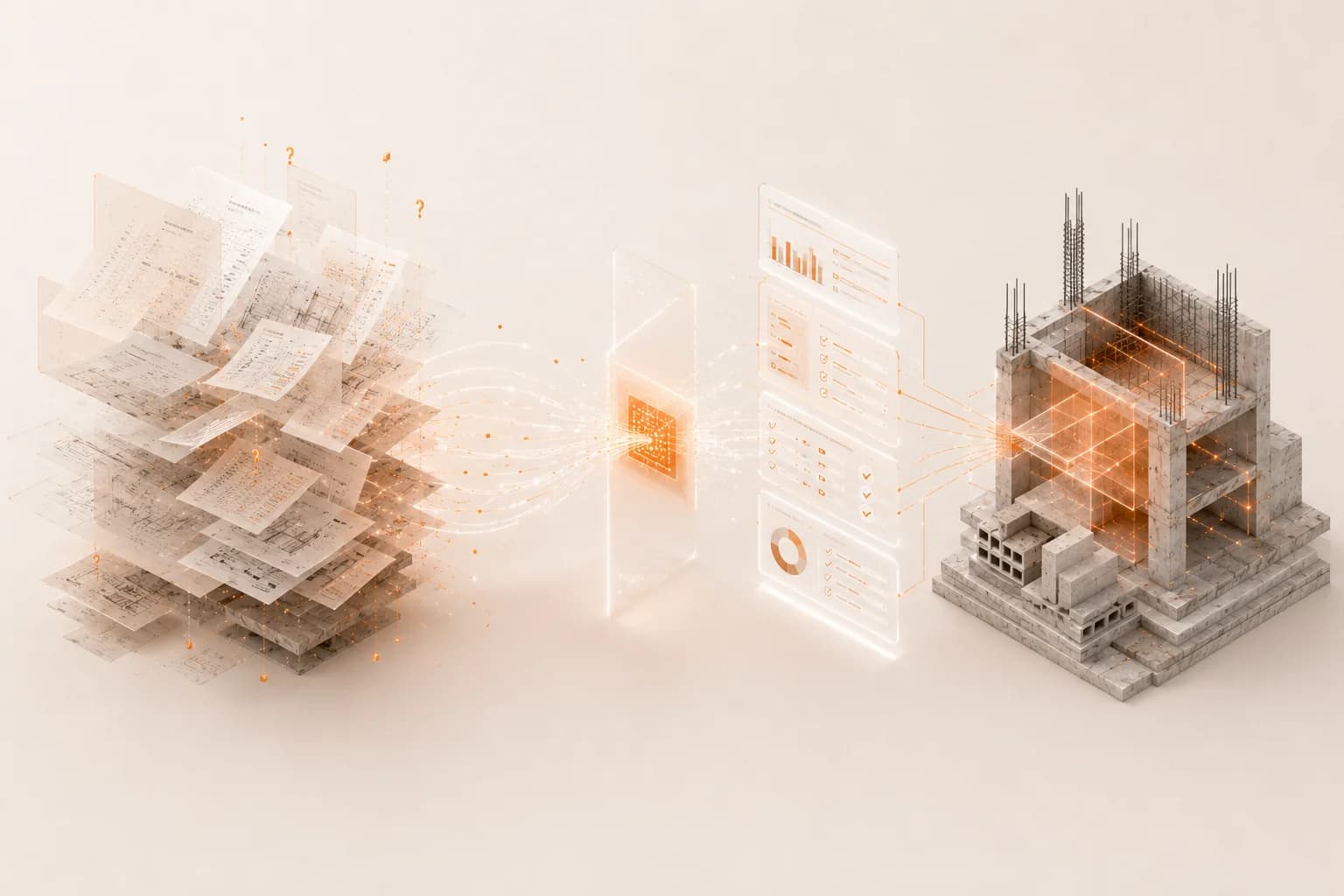
Construction Tender Document Analysis: Manual vs. AI
A comprehensive comparison of manual and AI-powered approaches to construction tender document analysis - speed, accuracy, cost, and risk.
Quick Answer
Construction tender document analysis is a critical process that demands precision, speed, and comprehensive risk detection. Manual analysis by experienced teams takes 40-80 hours per tender and carries a 15-30% error rate due to cognitive load and overlooked clauses. AI-powered platforms like Brickato reduce analysis time to 2-4 hours with 93%+ accuracy, instantly flag contractual risks, and handle mixed-language documents (multilingual/English), scanned PDFs, and handwritten annotations - capabilities that manual processes struggle with at scale. For contractors managing 20+ tenders annually, the difference translates to recovering 400-1,600 hours and preventing 30%+ contractual disputes triggered by BOQ ambiguities and missed fine print.
Table of Contents
- Why Tender Document Analysis Matters
- The Manual Tender Analysis Process: Step by Step
- Manual vs. AI: A Complete Comparison
- The AI-Powered Tender Analysis Process
- How Brickato Handles Tender Document Analysis
- Real-World Examples: What AI Catches That Humans Miss
- Tender Analysis Challenges and Beyond
- FAQ: Tender Document Analysis
- Key Takeaways
Why Tender Document Analysis Matters
Tender documents are the legal and operational foundation of every construction project. A single ambiguous clause, a missed penalty term, or an overlooked BOQ (Bill of Quantities) discrepancy can cost a contractor tens of thousands of dollars - or worse, trigger project delays and disputes that erode profitability.
Consider the scale: ** alone sees 93,775 tender-bids annually**, and the construction industry globally loses $177 billion to rework and disputes. Much of that loss stems from inadequate tender analysis - teams missing contractual nuances, misinterpreting scope boundaries, or failing to identify cost overrun triggers early enough.
The stakes are even higher today. Tender documents are increasingly complex:
- Mixed language requirements: local tenders often blend multiple languages, creating interpretation gaps
- Multi-format submissions: PDFs, scanned images, handwritten notes, Excel spreadsheets, Word documents - all in one tender package
- Volume pressure: Contractors responding to 20+ tenders monthly must analyze thousands of pages under time constraints
- Regulatory changes: Building codes, safety standards, and compliance requirements constantly evolve, making historical templates unreliable
Traditional manual analysis - even by experienced estimators and contract managers - struggles to keep pace. The question contractors face today isn't whether to adopt AI, but when and how to do it effectively.
The Manual Tender Analysis Process: Step by Step
Step 1: Document Collection and Organization
A tender package arrives - typically 50-200+ pages across multiple formats. An estimator or contract manager prints or downloads everything, then manually organizes documents into categories: technical specifications, BOQ, contractual terms, site conditions, insurance requirements, and more.
Time invested: 2-3 hours
Pain point: Large packages from different clients use different organizational schemes. A document labeled "Scope" in one tender might be "General Conditions" in another. Manual categorization is inconsistent and error-prone.
Step 2: Specification Review
The team reads through technical specifications, often line-by-line, making notes on materials, quality standards, equipment requirements, and construction methodologies. They cross-reference specifications against past project experience and supplier capabilities.
Time invested: 8-12 hours
Pain point: Specification sections often contain embedded cost drivers buried in subsections. A buried requirement like "all steel must be stainless Grade 316" (instead of standard Grade 304) can add 30-40% to material costs, but it's easily missed if the reviewer is skimming.
Step 3: Bill of Quantities (BOQ) Analysis
The team itemizes every line in the BOQ, checks unit prices against historical data, identifies missing items, and flags quantity discrepancies. This is labor-intensive and numerically critical.
Time invested: 10-15 hours
Pain point: BOQ ambiguities cause 30%+ of contractual disputes post-award. Examples: unclear measurement units (cubic meters vs. running meters), overlapping scope items, or hidden exclusions. Humans reviewing at speed miss these nuances.
Step 4: Contract Terms and Conditions Review
A dedicated contract manager (if the company has one) reviews General Conditions, liquidated damages clauses, payment terms, change order procedures, insurance requirements, and dispute resolution mechanisms.
Time invested: 8-15 hours
Pain point: Contract terms are dense, often using boilerplate language across multiple tenders. Reviewers may skim familiar-looking sections and miss critical variations - like a liquidated damages cap of 5% in one tender versus 15% in another.
Step 5: Risk Identification and Cost Estimation
The team synthesizes everything above into a risk register and cost estimate. They flag concerns (e.g., aggressive timelines, unclear scope) and incorporate risk premiums into their bid.
Time invested: 5-8 hours
Pain point: Risk identification is subjective and heavily influenced by who's reviewing the documents. An experienced contracts manager might catch a problematic escalation clause; a junior estimator might miss it entirely. Consistency across bids is low.
Step 6: Bid Preparation and Sign-Off
The team prepares the tender response (often in a client-specified format), consolidates their analysis, and seeks management approval before submission.
Time invested: 3-5 hours
Total manual process: 40-80 hours per tender
Manual vs. AI: A Complete Comparison
The following table compares manual and AI-powered tender analysis across key dimensions:
| Dimension | Manual Analysis | AI-Powered Analysis |
|---|---|---|
| Time per Tender | 40-80 hours | 2-4 hours |
| Accuracy Rate | 70-85% (human error, fatigue, cognitive load) | 93-97% (pattern recognition, no fatigue) |
| Cost per Tender | $2,000-$4,000 (labor, assuming $50-75/hr) | $100-$300 (subscription-based, amortized across tenders) |
| Language Support | Single language per document; mixed-language documents require human translation | Native support for multilingual support, English, and 100+ languages within same document |
| Document Format Handling | PDFs and Word only; scanned documents require OCR step; handwritten notes require manual transcription | All formats: PDF, Word, Excel, images, handwritten, scanned - all processed automatically |
| Risk Detection | Depends on reviewer experience; high variance | Systematic; flags contract red flags, BOQ ambiguities, cost overrun triggers, regulatory gaps |
| Consistency | Varies by reviewer; difficult to enforce standards across teams | 100% consistent methodology across all tenders and team members |
| Scalability | Team growth required; cost scales linearly with volume | Scales infinitely; cost per tender decreases with volume |
| Speed of Follow-Up Questions | "What are liquidated damages terms?" takes manual search (30+ min); answer lacks citation | Instant answers (15 seconds) with exact page and section references |
| Learning from Past Tenders | Manual case-by-case; institutional knowledge is fragile | AI learns from organization's project history; recommendations improve over time |
| Audit Trail | Ad-hoc notes, if any; difficult to reconstruct decision rationale | Full audit trail; every flag, citation, and recommendation is documented |
The AI-Powered Tender Analysis Process
Step 1: Document Upload and Unified Processing
Upload all documents - regardless of format - to the AI platform in seconds. The system automatically:
- Converts scanned PDFs to searchable text via OCR
- Extracts data from Excel BOQs
- Processes handwritten annotations
- Identifies language (multilingual, English, mixed)
- Organizes documents into intelligent categories
Time invested: 2-5 minutes
Advantage: All documents processed uniformly; no manual categorization required.
Step 2: Instant Specification Analysis
Ask the AI: "What materials are required? What quality grades? What are the cost drivers in the specifications?"
The AI scans all technical specifications, extracts material requirements, quality standards, and embedded cost drivers - then returns results with exact citations (e.g., "Page 12, Section 3.4: Stainless steel Grade 316 required for all exposed fasteners").
Time invested: 1-2 minutes (mostly your time to ask questions)
Advantage: No human skimming; embedded cost drivers are surfaced consistently.
Step 3: Automated BOQ Analysis
The AI scans the Bill of Quantities and instantly provides:
- Complete itemization with unit types and quantities
- Flagged ambiguities (overlapping scope items, unclear units, missing items)
- Comparison against historical projects in your database
- Anomalies (items significantly higher/lower in quantity than past tenders)
Time invested: 2-5 minutes (depends on BOQ size)
Advantage: BOQ ambiguities - which cause 30%+ of disputes - are flagged automatically before bid submission.
Step 4: Contract Terms Extraction and Risk Flagging
The AI automatically extracts and flags:
- Liquidated damages terms (amount, cap, trigger conditions)
- Payment schedules and holdback percentages
- Change order procedures and cost adjustment mechanisms
- Insurance and bonding requirements
- Dispute resolution clauses
- Ambiguous or non-standard terms compared to your contract database
Time invested: 1-2 minutes (fully automated)
Advantage: Contract risk is systematized; no reliance on individual reviewer expertise.
Step 5: Organization-Aware Risk Assessment
If you've uploaded past projects, the AI contextualizes risks based on your company's history:
- "Based on your experience with this client, liquidated damages of 10% are at the high end"
- "Your average project timeline is 18 months; this tender's 12-month schedule is aggressive"
- "You've successfully managed scope changes in 85% of past projects; this tender's change order process is stricter than usual"
Time invested: 2-3 minutes (fully automated, requires baseline data)
Advantage: Risk assessment is comparative and contextual, not absolute.
Step 6: Executive Summary and Bid Decision Support
The AI generates a concise executive summary: scope overview, identified risks, recommended bid strategy, and confidence level on profitability.
Time invested: 1 minute (fully automated)
Total AI-powered process: 2-4 hours (mostly leadership review of recommendations, not analysis)
How Brickato Handles Tender Document Analysis
Brickato is built on a simple principle: construction professionals should spend time making decisions, not processing documents.
What Makes Brickato Different
1. Native multiple languages Support contractors face a unique challenge: tenders mixing multiple languages, sometimes within the same clause. Brickato was built for this reality. You upload a tender - regardless of language mix - and the AI understands context in both languages simultaneously. No translation lag, no interpretation errors.
2. Organization-Aware Intelligence Brickato learns your company's profile:
- Past projects and their outcomes
- Your typical project margins and profitability targets
- Your team's capacity and skill sets
- Contracts you've signed before (to spot deviations in new tenders)
When analyzing a new tender, Brickato contextualizes risks against your specific situation. A 12-month timeline might be aggressive for you but standard for a larger competitor. Brickato flags what matters to your business.
3. Comprehensive Document Support Every format construction companies use:
- PDFs (including scanned, handwritten)
- Word documents
- Excel spreadsheets (BOQs, cost estimates)
- Images and photographs
- Mixed-language documents
- Historical contracts and reference materials
Upload everything in one folder; Brickato processes it all.
4. Cited, Traceable Answers Ask any question - "What are the liquidated damages terms?" "Are there conflicting scope definitions between the specification and BOQ?" "What's the payment schedule?" - and get instant answers with exact citations: page number, section heading, relevant text snippet.
This means:
- You can verify answers (no black-box AI)
- Your team can reference the same location during bid and project execution
- Disputes are resolved faster (you have a documented citation trail)
5. Systematic Risk Flagging Brickato doesn't just answer questions; it proactively flags risks you might miss:
- BOQ ambiguities: Overlapping scope items, inconsistent units, hidden exclusions
- Contract red flags: Non-standard terms, aggressive penalty structures, change order bottlenecks
- Scope mismatches: Conflicts between specification and BOQ
- Regulatory gaps: Missing insurance, bonding, or compliance requirements
- Cost overrun triggers: Ambiguous unit prices, scope creep language, escalation clauses
Each flag includes risk level (high, medium, low) and recommended mitigation.
6. Learning from Your Portfolio Over time, as you upload tenders and projects, Brickato learns:
- Which clients are high-risk (frequent changes, disputes)
- Which contract terms correlate with project problems
- Your team's accuracy in estimating specific scope items
- Market trends in tender requirements and pricing
This learning improves recommendations on every new tender.
Typical Brickato Workflow
- Upload: Drag tender folder into Brickato (all formats supported)
- Auto-Analysis: AI processes documents in parallel (2-4 minutes)
- Review: Scan executive summary, risk flags, BOQ analysis
- Ask Questions: "What's the project timeline?" "Are there retainage terms?" "Any unusual insurance requirements?"
- Decide: Armed with verified, cited information, prepare your bid
- Execute: Reference the same Brickato analysis during project delivery
Actual time commitment: 45 minutes to 2 hours (mostly your time to make decisions)
Cost per tender: Typically $100-$300 depending on document volume and subscription tier
Real-World Examples: What AI Catches That Humans Miss
Example 1: The Hidden Cost Driver
Situation: A 200-page specification for a commercial building renovation tender. An estimator reviews it in 8 hours, then prepares a bid.
What the estimator missed: Buried in Section 4.7 (HVAC Systems), sub-section 4.7.3, a single sentence: "All ductwork shall be insulated with 50mm fiberglass, minimum R-value 8.5."
This specification is 2x stricter than the standard R-value 4.0 used in the BOQ. The cost impact: +$45,000 for a $300,000 project - a 15% surprise cost that destroyed profitability.
What Brickato caught:
- Scanned the entire specifications for performance requirements and material grades
- Flagged: "HVAC insulation R-value 8.5 specified (Section 4.7.3) but BOQ assumes standard R-value 4.0 - cost mismatch detected"
- Highlighted the exact page and section
- Estimated cost variance: $40,000-$50,000
Outcome: The team adjusted their bid or declined to pursue the tender. No post-award surprise.
Example 2: The Contractual Trap
Situation: A contractor reviews a 150-page tender for a government infrastructure project. The contract terms look standard at first glance.
What the contract manager missed: Two different liquidated damages clauses in different sections:
- Section 2.5 (General Conditions): "Liquidated damages of $500/day for delays, capped at 10% of contract value"
- Section 8.2 (Special Conditions): "Liquidated damages of $750/day for delays, capped at 15% of contract value"
The Special Conditions override the General Conditions, but the contract manager skimmed the General Conditions and submitted a bid assuming the 10% cap. Actual liability was 15%.
What Brickato caught:
- Flagged multiple liquidated damages clauses
- Highlighted the conflict: "Two liquidated damages provisions detected. Special Conditions (Section 8.2) override General Conditions (Section 2.5)"
- Specified the exact differences: $750/day vs $500/day, 15% cap vs 10% cap
- Risk assessment: "Higher cap and rate apply - 15% exposure vs anticipated 10%"
Outcome: The team adjusted their contingency reserve and risk premium before bidding.
Example 3: The BOQ Ambiguity
Situation: A tender for interior construction work includes two separate BOQ line items:
- Item 15: "Drywall installation, 1,500 m²"
- Item 23: "Partition wall construction, 800 m²"
Are these overlapping? Is drywall included in partition wall construction, or separate? The specification doesn't clarify.
What the estimator assumed: Partition wall construction includes drywall. They estimated the 800 m² as complete partitions.
What the client meant: Partition wall construction (framing only), and drywall is separate. Item 15 is for drywall on existing walls; Item 23 is partition framing. The 800 m² of partitions still need drywall on both sides (~1,600 m² additional drywall).
Post-award reality: The contractor submitted an invoice for 800 m² of drywall on partitions. The client rejected it, citing the separate BOQ item. Legal dispute ensued.
What Brickato caught:
- Flagged overlapping scope definitions: "Drywall installation (Item 15) and partition wall construction (Item 23) have overlapping scope. Clarify: Does partition wall construction include drywall?"
- Recommended resolution: "Ask client for clarification before bid submission - specify whether partition wall construction is framing-only or includes both sides of drywall."
Outcome: The team asked the client for clarification during the tender Q&A process, got a written response, and avoided the post-award dispute.
Example 4: The Mixed-Language Risk
Situation: An local tender with specifications in multilingual and a BOQ in English. Key terms are inconsistent:
- multilingual spec: "בטון חוזק 40 מגהפסקל" (Concrete strength 40 MPa)
- English BOQ: "Concrete grade C35 (35 MPa)"
A manual review - even by a bilingual estimator - might miss this discrepancy because they're switching contexts between documents.
What Brickato caught:
- Processed both languages simultaneously
- Flagged: "Concrete strength mismatch: Specification requires 40 MPa (multilingual), BOQ specifies C35 (35 MPa)"
- Cost impact: +$8,000 for upgraded concrete strength
Outcome: Team clarified before bidding; no post-award disputes.
Tender Analysis Challenges and Beyond
Challenge 1: Volume and Time Pressure
contractors managing 20+ tenders monthly face a throughput crisis. At 40-80 hours per tender, analyzing 20 tenders requires 800-1,600 hours annually - equivalent to one full-time employee dedicated purely to tender analysis.
AI impact: The same 20 tenders can be analyzed in 40-80 hours (using 1 hour per tender), freeing the team for strategic decision-making.
Challenge 2: Mixed-Language Complexity
local construction is bilingual (multilingual/English) and often trilingual (multilingual/English/Arabic). A single tender may have:
- Specifications in multilingual
- BOQ in English
- Client correspondence in multilingual
- Standards references in English
- Handwritten notes in mixed languages
Manual translation and cross-referencing introduce errors and time delays.
AI impact: Native multi-language support means no translation lag, no interpretation errors, instant cross-document search in any language.
Challenge 3: Document Heterogeneity
Tender packages include:
- PDFs (sometimes scanned, sometimes digital)
- Word documents (often with tracked changes, inconsistent formatting)
- Excel spreadsheets (BOQs with complex formulas, cost sensitivity models)
- Images (site photos, regulatory documents, historical references)
- Handwritten notes (site visits, client feedback)
Manual consolidation of these formats into a coherent analysis is tedious and error-prone.
AI impact: All formats processed in parallel; unified analysis across heterogeneous sources.
Challenge 4: Expertise Dependency
Tender analysis quality depends heavily on individual expertise. A junior estimator may miss contract nuances that a senior contract manager catches. This creates:
- Inconsistency across bids
- Knowledge loss when experts leave
- Training gaps for new team members
AI impact: Systematic, consistent analysis independent of individual expertise. Institutional knowledge is preserved and scaled.
Challenge 5: Regulatory and Standard Evolution
Building codes, safety standards, and compliance requirements change frequently. Historical templates and assumptions become outdated.
AI impact: AI trained on current regulations and standards flags compliance gaps systematically.
FAQ: Tender Document Analysis
Q1: How accurate is AI for tender document analysis? Can I trust the results without human review?
A: AI-powered analysis achieves 93-97% accuracy on factual extraction (pulling BOQ items, identifying contract terms, spotting contradictions). However, tender analysis isn't purely mechanical - it requires judgment calls.
Here's our recommendation:
- Trust AI for factual extraction: Contract terms, payment schedules, deadlines, specific cost items. These are verifiable; if the AI extracts a liquidated damages clause, you can verify it directly in the document.
- Use AI to support judgment: Risk assessment and bid decisions should always involve human expertise. The AI flags a risk; you assess whether it's material to your business.
- Always verify cited answers: Brickato provides page and section references for every fact. Spot-check 10-15% of findings during your first few uses; you'll develop trust quickly.
For teams managing high-volume tenders, AI reduces analysis time by 95% while maintaining or improving accuracy compared to manual analysis (which has 70-85% accuracy due to fatigue, time pressure, and cognitive load).
Q2: What if a tender is in a language my team doesn't speak fluently?
A: This is a common challenge for international contractors or those working in multilingual regions.
AI-powered platforms like Brickato handle this through:
- Direct analysis in the original language: The AI understands the document in its native language (multilingual, Arabic, Spanish, Mandarin, etc.)
- Extracted summaries in English (or your preferred language): Key terms, risks, and findings are presented in a language your team understands
- Cited original references: You can verify extracted information by reviewing the cited original language text
This is faster and more accurate than manual translation, which introduces interpretation errors.
Q3: How does organization-aware analysis work? What data does Brickato need?
A: Brickato learns from your company's project history to contextualize risks and recommendations.
Data needed (optional, but makes recommendations more valuable):
- Past project outcomes (profitability, delays, disputes)
- Contract templates you commonly use
- Client history (which clients are high-risk, which are reliable)
- Team capacity and skill set
Data you don't need to provide:
- Financial data beyond project margins
- Proprietary estimating models
- Detailed cost breakdowns
Privacy: All data is encrypted and segregated per organization. Brickato doesn't share your data with competitors or use it to train general-purpose models.
Q4: Can AI handle scanned or handwritten tender documents?
A: Yes, and this is a major advantage over manual processes.
AI platforms use OCR (Optical Character Recognition) to convert scanned documents to searchable text, and can process handwritten annotations. This handles:
- Scanned PDFs (poor quality, low contrast)
- Handwritten notes on site plans
- Faxed documents
- Photographs of documents
Accuracy: OCR accuracy is 95%+ for clear scans, 85-90% for poor-quality scans. Brickato flags uncertain extractions so you can verify them manually.
Manual processes require manual transcription of these documents - a time-consuming, error-prone step that AI eliminates.
Q5: How long does it take to get results? Can I get analysis in real-time?
A: Yes, with caveats on what "real-time" means.
Timeline:
- Document upload and processing: 2-5 minutes (depending on file size and format)
- Automated analysis: 1-2 minutes (BOQ analysis, contract extraction, risk flagging)
- Your time to review and ask questions: 30-60 minutes (you ask 5-10 questions like "What's the payment schedule?" and review AI answers)
Total: 45 minutes to 2 hours from upload to actionable insight.
True real-time elements:
- Follow-up questions are answered in 10-30 seconds with cited results
- Risk flags appear during initial analysis (no waiting)
- Comparisons to past projects are instant (if you've uploaded historical data)
For a 40-80 hour manual analysis process, 2 hours is effectively real-time.
Key Takeaways
-
Manual tender analysis is broken at scale: 40-80 hours per tender, 70-85% accuracy, inconsistent quality, and high error rates drive post-award disputes and lost profitability.
-
BOQ ambiguities are costly: 30%+ of contractual disputes originate from Bill of Quantities misunderstandings. AI-powered analysis flags these ambiguities before bid submission.
-
AI saves 95% of analysis time: AI reduces tender analysis from 40-80 hours to 2-4 hours, freeing estimators and contract managers for strategic decision-making.
-
Organization-aware AI is more valuable than generic AI: Contextualizing risks against your company's history, past projects, and team capacity makes recommendations actionable, not theoretical.
-
Multi-language and multi-format support is essential: local and international contractors need platforms that handle multilingual/English mixed documents, scanned PDFs, handwritten notes, and Excel BOQs natively.
-
Cited, verifiable answers build trust: AI should reference exact page and section numbers, allowing you to verify and explain decisions to stakeholders.
-
Scalability is the real ROI: As you grow from 5 to 20 to 50+ annual tenders, manual analysis becomes a bottleneck. AI scales infinitely.
-
Risk flagging prevents costly disputes: Spotting contract red flags, BOQ mismatches, and scope ambiguities before bidding reduces post-award disputes and protects profitability.
For contractors and construction firms globally, the shift from manual to AI-powered tender analysis isn't a luxury - it's a necessity for competing effectively in a high-volume, time-pressured market.