
Introducing Brickato
Construction is broken - not in the dramatic way, but in how teams spend 35% of their time hunting for information. We built Brickato to change that.
Construction is broken. Not in the way that headlines make it sound - with dramatic statistics about delay and cost overruns. That's background noise. Construction is broken in a specific way that nobody talks about: information chaos.
Walk onto any active site, visit any contractor office, and you'll see the same thing. A team frantically scrolling through PDFs. Searching email for a specification they saw three months ago. Opening the same BOQ document five times because nobody remembers where the change order was applied. Spending 35% of their day hunting for information that exists somewhere in the project - they just can't find it.
This isn't a failure of effort. It's a failure of the tools built for the industry.
For two decades, the standard software solutions for construction have been Procore, Bluebeam, PlanGrid, Fieldwire. They're solid products in their domains. They manage workflows, coordinate tasks, mark up drawings. But they were built before AI. They were built for a different era. And they haven't fundamentally changed how teams access the knowledge locked inside their documents.
We started Brickato because we realized something: the construction industry doesn't need another project management tool. It needs a new way to talk to its documents.
The Document Problem
Construction runs on documents. Tenders with hundreds of pages. Specifications in multiple formats. Bill of quantities spreadsheets with conditional cells and notes written in the margins. Site photos. Handwritten change orders. Scanned contracts from vendors. Every project contains the answers to almost every question a team will ask. The problem is finding them.
Right now, that means manual search. It means oral history - asking someone who was there. It means risk: missing a detail that costs you 30,000 NIS in a dispute, or worse, discovering mid-execution that the BOQ and the specification conflict.
When you add up the real costs, it's staggering. Tender analysis takes 40 to 80 hours of manual review. A contractor we spoke with estimated their organization was losing 15% of margin to information fragmentation alone. And the industry has accepted this. It's just how construction works.
Except it doesn't have to be.
Why Now?
Three things came together. First, large language models got good enough to understand construction documents with semantic precision. Second, multimodal AI can read handwritten notes and scanned PDFs without preprocessing - messy documents, the kind construction uses daily, now work. Third, the construction industry, where we're based, was ready to move faster than the global standard.
That last point matters. multilingual is not well-served by English-first software. A contractor reviewing a tender doesn't think in English. The documents are in multilingual. The calculations are in multilingual. The context is multilingual. Building an AI construction platform for multilingual support, we realized, meant building something that works better for construction itself. We could optimize for the actual problem instead of retrofitting a global product.
We also realized we could start small. Mid-market contractors - the C3 to C5 classified firms with 5 to 500 people - don't need enterprise-grade complexity. They need clarity. They need speed. They need to know exactly where an answer came from. And they need pricing that doesn't require board approval.
What Brickato Does
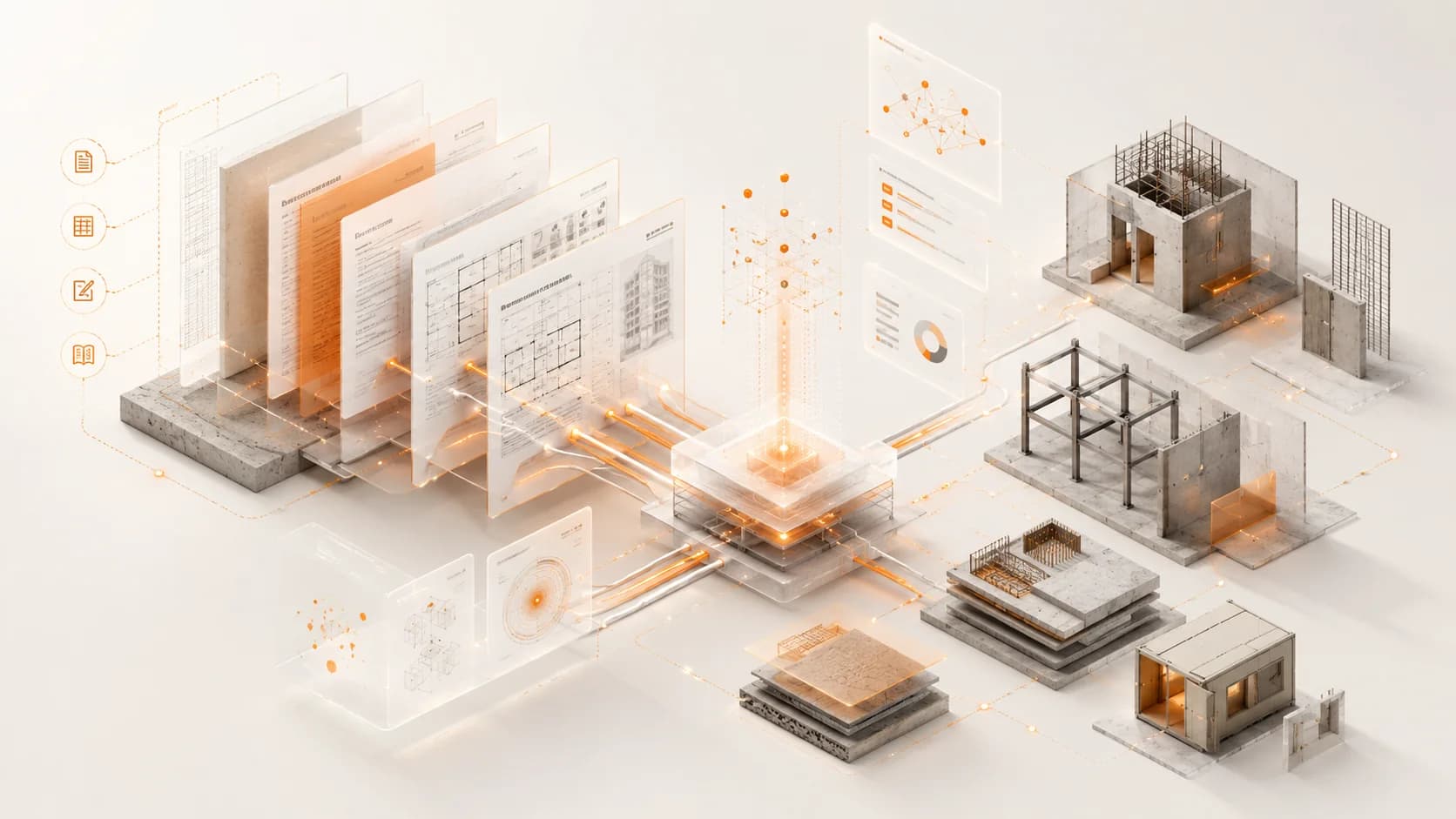
You upload a document. Any document. PDF, Word, Excel, images, scanned blueprints, handwritten notes. Brickato reads it.
Then you ask questions in natural language. "What's the concrete specification for the foundation?" "Which items in the BOQ have conditional pricing?" "Did we include waterproofing in the scope?" "Show me all the payment milestones." "What did the vendor say about delivery time in their letter?"
Every answer comes with citations. Not a vague reference - the exact page, the exact section, the exact document. You can verify it immediately. You can show it to your team, your client, the lawyer. There's no ambiguity.
That sounds simple. It only sounds simple because we've done the hard work to make it that way.
Under the hood, we're running a hybrid retrieval system. BM25 for keyword precision, vector embeddings for semantic understanding, GraphRAG for relational context, Cohere reranking for accuracy. We're using Claude for reasoning and Gemini Flash for OCR because we needed the best-in-class models for construction documents. The system learns from your organization's context - your previous projects, your terminology, your patterns - so every query gets smarter.
But you don't see any of that. You just ask and get an answer you can trust.
Full Lifecycle Intelligence
The real insight, though, is that documents don't stay static. A tender becomes a contract. A contract spawns change orders. Execution generates site reports. Close-out requires compliance documentation. These documents are connected. They reference each other. Understanding one requires understanding the others.
That's why Brickato works across the full project lifecycle. From tender analysis - helping you understand scope, pricing, and risk before you bid - through execution, where teams query specifications and BOQs in real time, to close-out, where you're assembling compliance documentation and reviewing contractual obligations.
One platform. One place for your project's complete document intelligence.
Designed for Construction, Not Corporate
We built Brickato to solve problems we understood intimately. That meant making decisions other companies wouldn't make.
We support scanned documents and handwritten notes because that's what construction uses. We built multi-language because that's the language of our users. We made citations mandatory because contractors need defensibility. We designed organization-aware intelligence because your company's context matters. And we built transparent, straightforward pricing - free tier, per-project pricing at $300, $1K, $5K - because we didn't want anyone calculating ROI spreadsheets to justify an AI tool.
We also didn't build it for everyone. Mid-market contractors need something different from large enterprises. Enterprises need consultants and custom integration and support teams. We built for contractors who want to move fast, iterate, and see results without organizational overhead.
The Opportunity
Construction accounts for 13% of global GDP. It's one of the least digitized industries on the planet. A 5% efficiency gain in document handling represents billions of dollars. But that's not why we're doing this.
We're doing it because construction teams are smart, hardworking, and frustrated. They deserve tools built by people who understand their world. Tools that work with their reality instead of forcing them to conform to software logic. Tools that give them back the time they're spending hunting for information.
The window for that is right now. AI is good enough. The cost structure is right. The problem is enormous and obvious. And the competitors that owned this space - they're not building this. They're managing existing products. They're profitable. They're not innovating.
That's where we come in.
Try It
Brickato is live. You can start free. Upload a document, ask a question, see if this changes how you think about the information in your projects.
No credit card required. No enterprise sales process. No wondering if it actually works for your use case.
Go to brickato.com and try it.
The construction industry is too important and too fragmented to stay this way. We're building something different, and we want to build it with people who see the problem the same way we do.
If you do, let's talk.
Or Yaakov Chief Revenue Officer, Brickato