
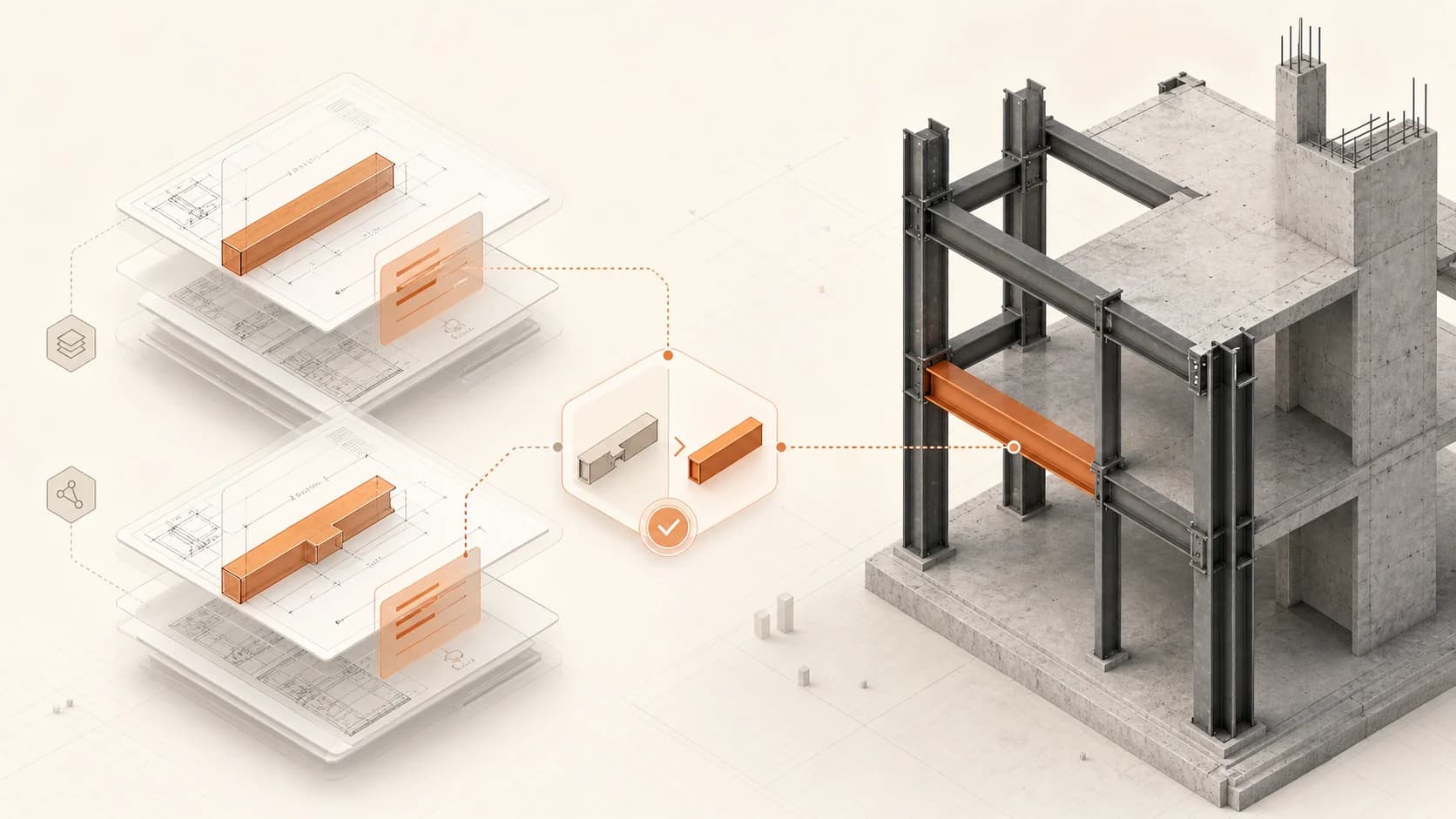
How to Find Contradictions in Tender Documents
A practical workflow for finding conflicts between specifications, drawings, BOQs, addenda, and schedules before submitting a construction tender.
Quick answer
To find contradictions in a construction tender package, start by locating the contract's order of precedence. Then review the package by subject, not one document at a time. Cross-check every requirement that can affect cost, scope, time, quality, or liability across the specifications, drawings, BOQ, schedules, addenda, and clarifications.
Record each conflict with an exact document, page, and clause reference. Classify it as a contradiction, ambiguity, or omission. Finally, either submit a focused clarification or document the pricing assumption before the bid closes.
AI can make the first pass much faster, but only when every finding links back to its source. The final decision still belongs to the tender team.
Table of contents
- What counts as a document conflict?
- Step 1: Find the order of precedence first
- Step 2: Review by subject, not by document
- Step 3: Build a contradiction register
- A fire protection coating example
- Step 4: Rank conflicts by bid impact
- Step 5: Write clarification questions that can be answered
- Step 6: Price unresolved conflicts deliberately
- Where AI helps, and where it does not
- The 48-hour tender contradiction checklist
- Frequently asked questions
One drawing says 40 MPa concrete. The BOQ prices 30 MPa. The specification points to a note that was revised in an addendum. Which requirement goes into your price?
That is not a paperwork problem. It is a margin problem.
The contradiction that appears at 4:10 p.m.
It usually happens late.
The estimate is nearly finished. Supplier quotes are in. The commercial team is reviewing qualifications. Then someone notices that the structural notes require one concrete grade while the BOQ names another.
The difference may look small on one line. Across several floors, it can change material cost, testing requirements, supplier availability, and programme risk. If the team prices the cheaper requirement and the contract gives priority to the stricter one, the gap comes straight out of margin.
The expensive part is rarely the contradiction itself. The expensive part is discovering it after submission, award, or mobilisation.
What counts as a document conflict?
Tender teams often use the word "contradiction" for three different problems. Separating them makes the next action clearer.
| Type | What it means | Example |
|---|---|---|
| Contradiction | Two documents give incompatible requirements for the same item | The drawing requires 40 MPa concrete while the BOQ lists 30 MPa |
| Ambiguity | A requirement can be interpreted in more than one reasonable way | "Approved equivalent" is allowed, but no approval process is defined |
| Omission | A necessary item appears in one source but is absent from another | Intumescent fire protection is required for the steel frame but has no measurable BOQ item |
All three can affect the bid. They should not all be handled in the same way. A contradiction needs a governing answer. An ambiguity needs a defined interpretation. An omission needs a scope and pricing decision.
When the gap is a missing or mismatched quantity, see When the BOQ Doesn't Match Reality.
Step 1: Find the order of precedence first
Before comparing documents, find the clause that says which document governs when two requirements conflict.
A tender package may give priority to addenda, tender conditions, project specifications, drawings, schedules, the BOQ, or general specifications. The sequence varies by client, jurisdiction, and contract form. Never assume that the order from the previous tender applies to this one.
Copy the exact precedence clause into the tender review file. Record the document name, revision, page, and clause number. This becomes the reference point for every conflict that follows.
If no clear order appears, that is a clarification item in its own right.
Step 2: Review by subject, not by document
Reading a 300-page specification and then opening the drawings two days later makes comparison dependent on memory. That is where conflicts disappear.
A better method is to choose one subject and trace it across the full package.
Start with the areas most likely to affect price or delivery:
- Materials and performance grades
- Dimensions, quantities, and units
- Scope ownership and trade boundaries
- Codes, standards, and revision dates
- Testing, inspection, and approval requirements
- Programme dates, milestones, and access constraints
- Warranties, maintenance, and handover obligations
- Commercial conditions, damages, bonds, and insurance
For concrete, for example, review the structural notes, relevant specification sections, BOQ items, drawing schedules, addenda, and clarification responses together. Do not move to the next subject until every relevant reference is captured.
Step 3: Build a contradiction register
A contradiction register turns scattered observations into decisions. It also prevents the same issue from being rediscovered by three different people.
Use a simple structure:
| Topic | Source A | Source B | Type | Possible impact | Owner | Action |
|---|---|---|---|---|---|---|
| Podium beam concrete | S-204, note 7 | BOQ 03.12 | Contradiction | Material cost and testing | Estimator | Submit clarification |
| Intumescent coating | Fire strategy FP-07 | BOQ 05.18, lump sum only | Ambiguity and quantity gap | Material, access, inspection, and programme | Bid manager | Request member schedule and approved thickness basis |
| Completion milestone | Conditions 8.2 | Programme appendix, row 14 | Ambiguity | Delay exposure | Commercial lead | Confirm date |
Every source reference should include four things:
- Document name
- Revision or issue date
- Page or drawing number
- Clause, note, or BOQ item
If a finding cannot be traced back to the source, it is not ready for the register.
A fire protection coating example: when one BOQ line hides five variables
Fire protection language can hide a large commercial risk because two different scopes are often described as if they were the same thing.
Firestopping seals penetrations, joints, and openings in fire-rated walls and floors. Intumescent coating is a reactive paint system applied to structural steel. When exposed to heat, it expands and forms an insulating char that delays the steel temperature rise.
Both belong to passive fire protection, but they are measured, specified, applied, and inspected differently. A tender team should never price one as a substitute for the other.
Consider this package:
- The fire strategy requires 90 minutes of protection for the exposed steel frame.
- The structural schedule contains beams, columns, hollow sections, and connection plates of different sizes.
- The project specification names an intumescent coating system.
- The BOQ contains one lump-sum line for "fire-resistant paint to structural steel."
- The tender does not include a member-by-member thickness schedule or a defined inspection method.
That is not a complete quantity. It is a scope placeholder.
Why the paint quantity is different for every steel member
Intumescent paint is not normally quantified by applying one coverage rate to the total steel area. The required dry film thickness, or DFT, must come from the approved coating system and its tested loading data.
The thickness can change with:
- The required fire resistance period
- The size and shape of the steel section
- The section factor, sometimes described as massivity
- The number of sides exposed to fire
- The design assumptions and limiting steel temperature used for the approved solution
A light section heats faster than a heavier section with a lower heated perimeter relative to its steel area. Two members painted the same colour can therefore require very different coating thicknesses to achieve the same fire resistance period.
The tender quantity should be built from a member schedule, not from a single average rate:
- Confirm the fire resistance requirement and the approved coating system.
- Extract each steel section, its length, location, and exposed faces.
- Map each member to the required DFT in the approved loading table or project thickness schedule.
- Calculate the coated surface area for each DFT band.
- Convert dry coating volume into theoretical wet paint using the product's volume solids.
- Add an agreed allowance for spray loss, overspray, repairs, and site conditions.
- Keep primer, intumescent coating, and topcoat quantities separate.
A useful quantity check is:
Dry coating volume in litres = coated area in square metres x DFT in microns / 1,000
The theoretical wet quantity is then the dry volume divided by the product's volume solids expressed as a decimal. The procurement quantity also needs a documented project allowance. This check does not replace the manufacturer's design, the approved thickness schedule, or the fire engineer's requirements.
The application requirements belong in the price
The coating itself is only one part of the scope. A compliant bid also needs to account for the conditions required to apply, inspect, and protect the complete system.
Before application, the team should confirm:
- The approved substrate preparation and cleanliness standard
- Primer type, compatibility, condition, and measured primer DFT
- Permitted steel temperature, air temperature, relative humidity, and dew-point margin
- Mixing, thinning, spray equipment, and maximum build per coat
- Drying and recoat windows between primer, intumescent layers, and topcoat
- Whether a topcoat is required for the exposure environment and whether it is part of the approved system
- Access, masking, edge treatment, connection details, and areas that will become inaccessible
During application, wet film thickness should be checked while the coating can still be corrected. After curing, the intumescent DFT should be measured with calibrated equipment and recorded by member or inspection zone before the topcoat is applied. Any destructive test location, transport damage, erection damage, or later trade damage needs an approved repair and a new inspection record.
ISO 2808 describes methods for measuring wet and dry film thickness. ISO 19840 defines a procedure for verifying and accepting dry film thickness on rough steel surfaces. Product-specific application manuals may add stricter inspection frequencies and acceptance rules. For example, the FIRETEX FX9502 application manual requires primer DFT to be established before the intumescent coating is applied and the intumescent DFT to be established before the topcoat. The project specification and approved system must define which requirements govern.
What goes wrong when the instructions are not followed
An under-thickness area may not deliver the specified fire resistance. That is the primary safety risk, but it is not the only project risk.
Excessive build, unsuitable application conditions, or insufficient drying time can cause sagging, incomplete cure, solvent entrapment, or other product-specific coating failures. An incompatible primer or topcoat can lead to adhesion failure. Contamination or moisture on the steel can cause the system to detach. Unrecorded damage after erection can leave a visible finish that no longer represents the approved fire protection system.
The commercial consequences arrive quickly:
- A quantity shortfall creates urgent procurement, additional access, and programme delay.
- A blanket high thickness creates unnecessary material and labour cost.
- Missing access, masking, inspection, and repair activities erode the subcontractor's margin.
- A coating applied before the primer is verified may need to be removed to establish the true DFT.
- A topcoat applied before the intumescent thickness is accepted can make correction slower and more expensive.
- Incomplete inspection records can lead to rejection even when the finished steel looks acceptable.
This is why the tender question should not be, "How many square metres of steel are there?" The better question is:
Please provide the approved member-by-member intumescent coating schedule, including required fire resistance, section factor or section classification, exposed faces, required DFT, approved primer and topcoat, inspection method, and responsibility for access and repairs. Please also confirm how this scope is measured and paid under BOQ item 05.18.
That question connects safety, quantity, execution, inspection, and payment in one answer. It gives the estimator a basis for price and gives the project team a record they can carry into procurement and quality control.
Step 4: Rank conflicts by bid impact
Not every inconsistency deserves the same attention. A useful triage is:
Red: The issue may change bid validity, major cost, scope, programme, or contractual exposure.
Amber: The issue affects execution assumptions or creates a moderate commercial risk.
Green: The difference is editorial or has no meaningful effect on price, scope, or compliance.
Review red items first. Give each one an owner and a deadline that leaves time before the formal clarification cutoff. A long register is not a sign of control if the most important five questions are still open on bid day.
Step 5: Write clarification questions that can be answered
"Please clarify the concrete grade" is easy to misunderstand and easy to answer vaguely.
A useful clarification shows the conflict, cites both sources, and asks for one decision.
Weak question
Please clarify the required concrete grade.
Better question
Drawing S-204, note 7, requires 40 MPa concrete for the podium beams. BOQ item 03.12 describes 30 MPa concrete for the same elements. Please confirm the governing strength and whether bidders should price BOQ item 03.12 on the basis of 40 MPa.
This format helps the client answer quickly. It also creates a clean record that can be carried into the bid assumptions and, if awarded, the contract file.
Step 6: Price unresolved conflicts deliberately
Some questions will not be answered before submission. Silence is not a pricing strategy.
For every unresolved red or amber item:
- Identify the requirement that appears to govern under the stated order of precedence.
- Estimate the cost and programme effect of the conservative interpretation.
- Decide whether to include an allowance, state an assumption, or add a qualification where permitted.
- Record who approved that decision.
- Carry the item into the tender handover if the bid is successful.
The goal is not to remove uncertainty. The goal is to make sure the business knows which uncertainty it accepted and where it sits in the price.
Where AI helps, and where it does not
The hard part of a contradiction review is often not professional judgement. It is search capacity.
Tender packages contain specifications, drawings, BOQs, addenda, schedules, and scanned appendices. The same requirement may be described differently in each one. A reviewer has to find every relevant reference before applying judgement.
Brickato's tender analysis platform reads tender instructions, specifications, and addenda in Hebrew, English, and Arabic. Tender teams can ask questions in natural language, compare requirements across uploaded documents, and review answers with page-level citations. That cited review uses domain intelligence for specifications and bills of quantities.
For example:
- Where do the structural specification and BOQ require different concrete grades?
- Which drawing notes introduce work that has no matching BOQ item?
- Do any addenda change the testing requirements in specification section 05?
- Which completion dates differ between the conditions and the programme appendix?
The citation is the important part. A confident answer without a source creates another thing to check. A cited answer takes the reviewer to the exact page, where the finding can be verified and moved into the contradiction register.
A cited answer is only as useful as the text it can point to. If a requirement exists only as geometry on a drawing, open the sheet and record the reference yourself.
AI should help the team find and connect evidence. It should not decide the legal meaning of a precedence clause, approve a commercial qualification, or replace professional review.
For the broader comparison of manual and AI tender review, see Construction Tender Document Analysis: Manual vs. AI.
The 48-hour tender contradiction checklist
- Confirm the latest revision of every tender document
- Add every issued addendum and clarification response
- Copy the order of precedence clause into the review file
- Cross-check the highest-value BOQ items against drawings and specifications
- Review materials, quantities, scope, standards, testing, dates, warranties, and commercial conditions
- Record every material finding with a document, page, and clause reference
- Classify each finding as a contradiction, ambiguity, or omission
- Assign an owner and priority to every red and amber item
- Submit clarification questions before the deadline
- Price and approve every material item that remains unresolved
- Include unresolved assumptions in the tender handover file
Frequently asked questions
Which document takes precedence when the specification and BOQ conflict?
The contract or tender package should define its own order of precedence. The answer varies between clients and contract forms, so do not rely on a general rule. Find and cite the clause for that tender. If the order is missing or unclear, submit a clarification.
Should every discrepancy become a clarification question?
No. Prioritise discrepancies that can affect compliance, scope, price, programme, quality, or contractual exposure. Minor editorial differences can remain in the internal register. Material conflicts should be clarified or covered by a documented bid assumption.
Can AI decide which requirement is legally binding?
No. AI can locate conflicting requirements and show the evidence. The tender team, with legal or commercial advice where needed, must interpret the contract and approve the bid position.
What if a contradiction is discovered after bid submission?
Record it immediately, check the tender rules, and escalate it to the commercial or legal owner before taking a position. The available response depends on the procurement process and contract terms. Do not rely on an informal conversation when the issue may affect scope or price.
How detailed should a contradiction register be?
Detailed enough for another team member to verify the issue without repeating the search. At minimum, include both source references, the type of conflict, the possible impact, the owner, and the agreed action.
Find the conflict while there is still time to price it
Tender risk rarely arrives as one obvious warning. It hides in a changed note, a missing BOQ line, an old standard, or two requirements that were never read side by side.
The teams that protect their margin are not the ones that remove every uncertainty. They are the ones that find uncertainty early, cite it clearly, and decide what to do before the bid closes.
Per-seat pricing is on the pricing page.
Start a 30-day Premium trial and review your next tender with sources attached to every answer.